Non-surgical spinal decompression · Bethesda, MD
Were you told your next step is injections or surgery? There is a non-surgical option for the disc.
From patients
C. W. Owen
Google review
Henry A.
Google review
Dickson
Google review
Why nothing has held
A damaged disc does not heal the way a muscle does.
You rested. You did physical therapy. You tried adjustments, medication, maybe an injection. Each one calmed the pain for a while, and none of them changed the disc, so the pain came back.
A disc has very little blood supply, and it is under load every time you sit, stand or bend. With no relief from that pressure, it cannot draw in the fluid and nutrients it needs to recover.
Non-surgical decompression takes the pressure off the disc gently and repeatedly as part of your program. That gives the disc the conditions it needs to change.
Prime Spine patient
Google review
How it works
A gentle, computer-guided stretch for the disc.
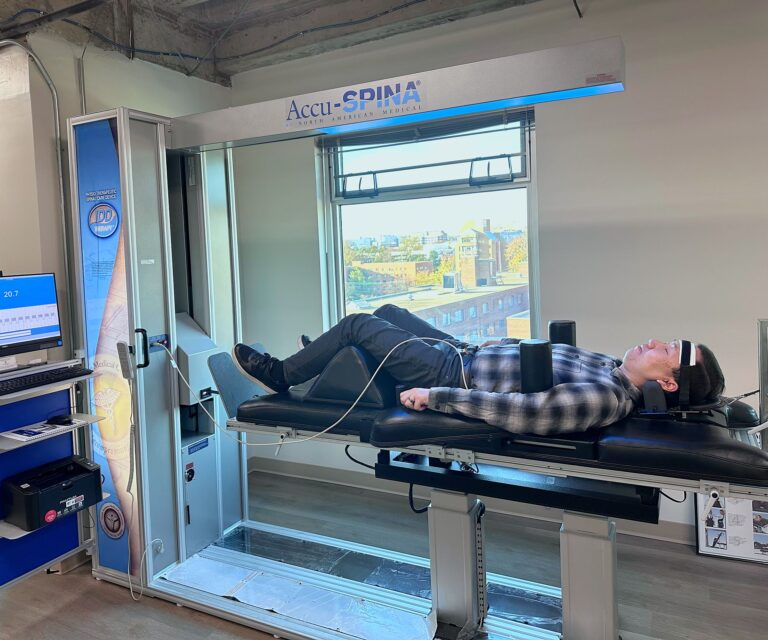
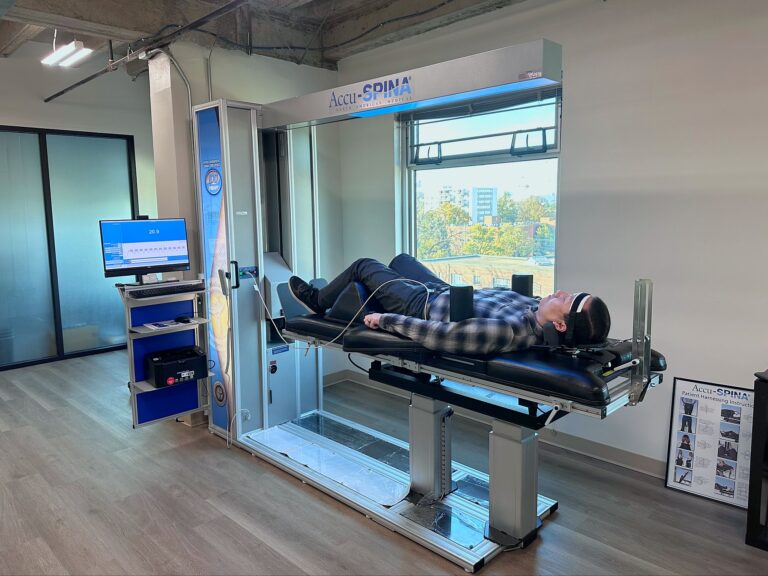
You lie on a padded table, fully clothed. The table gently stretches and releases the spine in slow cycles. There is no twisting and no cracking. Most people find it comfortable.
You can drive yourself home and go back to your day.
1
Evaluation with Dr. Lee
Your history, a full physical exam with a muscle and nerve function assessment, and your MRI or X-rays. She looks at how the pain behaves, not just where it is.
2
Your plan, built from her findings
Dr. Lee builds your program from what she finds at your evaluation and from your goals.
3
Regular re-exams
As your care goes on, Dr. Lee re-examines you and adjusts your plan.
Is this you?
Is non-surgical decompression a fit for you? Dr. Lee decides at the evaluation.
Non-surgical decompression is usually considered when
- Your pain has lasted months, or keeps coming back
- An MRI shows a herniated, bulging or degenerative disc, or your symptoms point to one
- Pain, numbness or tingling travels into a leg or an arm, or your neck pain reaches your shoulder or hand
- Therapy, medication or injections did not give lasting relief
- You have already had an injection or surgery and want to know whether non-surgical decompression is still an option
- You have been told the next step is injections or surgery and want to know your non-surgical options first
How Dr. Lee decides
- Your history: how long, what it feels like, what you have tried
- A physical exam with a muscle and nerve function assessment
- Your MRI or X-rays, matched against your symptoms
- A screen for the conditions that rule non-surgical decompression out
You get a clear answer at the evaluation, either way. We only accept cases we are confident we can help.
How it compares
What each option does for the disc.
Rest and medication
Dulls the pain for now
Rest calms a flare-up, and medication eases the pain while it lasts.
Neither one relieves the pressure on the disc, so the pain comes back once your normal routine resumes.
- Short-term relief. No change to the disc
Physical therapy
Builds strength around the spine
- Helpful support. No change to the disc
Adjustments on their own
Gets stiff joints moving
An adjustment frees up the joints of the spine and can ease pain for a time.
By itself, it does not relieve the pressure on a bulging or herniated disc. That is why Dr. Lee does not rely on adjustments alone.
- Relief for a time. No change to the disc
Injections
Settles the irritated nerve
A steroid injection near the nerve can calm a bad flare-up of nerve pain.
The disc pressing on the nerve does not change, and you can only have so many injections.
- Temporary. No change to the disc
Non-surgical spinal decompression
Relieves the pressure on the disc
- Works on the cause, so relief can last
- No needles, drugs or surgery
- You stay fully clothed on a padded table
- Every case evaluated by Dr. Lee herself
- A program built from her full evaluation
- Progress re-examined by Dr. Lee as you go
From patients
Lynette: four herniated discs, six weeks of care.
The problem
Four herniated discs, sciatica into the calf, could barely walk
What she had tried
Six weeks
What changed
No pain, walking without a limp
Prime Spine patient
Google review
Minna
Google review
Anney C.
Google review
Questions
About the treatment
No incision, no anesthesia, no injection, no drugs. You lie fully clothed on a padded table while a computer controls the pull. Dr. Lee screens every patient for the conditions that rule it out before any care starts, and she re-examines you at set points during care.
A session feels comfortable to most people, and some fall asleep. The pull starts gently and builds slowly, and the team adjusts the table whenever you ask.
Everyone is different. At your evaluation, Dr. Lee tells you what she would expect for your case and when your re-exam will be.
Traction and inversion apply one steady pull to the whole spine, and the muscles often tighten against it. The table used for non-surgical decompression is computer controlled. It works on one spot in your spine and cycles the pull on and off so the muscles stay relaxed.
An MRI or an X-ray both work. If you cannot get the images, bring the report, or email it to the office before your visit. No imaging yet? Come in for your evaluation anyway. If you need imaging, Dr. Lee refers you for it.
Park free in the reserved patient spots on levels 1 and 2 of the garage attached to the building. Look for the Prime Spine Wellness signs, then walk down to the building’s front entrance.
Yes. Most people keep working during their program, and the office plans your care around your day.
Insurance covers what it has a code for: short visits, medication, injections and surgery. It was never designed to cover a full program of care aimed at the disc itself, so most plans do not pay for a non-surgical decompression program. Dr. Lee builds your program from her full evaluation of your case, not from what a policy covers. Monthly payment options are available.
Yes. Non-surgical decompression and traction have been studied since the 1960s. See the research Dr. Lee points patients to →
It depends on the program Dr. Lee recommends, so there is no single price. She goes over the cost and monthly payment options with you at the evaluation.
Next step
See if you are a candidate.
Prime Spine Wellness
(301) 272-2050
4833 Rugby Avenue, Suite 402, Bethesda, MD 20814
EMAIL: PRIMESPINEWELLNESS@GMAIL.COM
Office Hours
- MON 11 AM – 2 PM and 3 – 6:30 PM
- TUES 11 AM – 2 PM and 3 – 6:30 PM
- WED 11 AM – 2 PM and 3 – 6:30 PM
- (Closed for lunch 2 – 3 PM)
- THURS 11 AM – 4:30 PM
- FRI 11 AM – 4:30 PM
- SAT and SUN CLOSED
- Free reserved parking on levels 1 and 2 of the attached garage. Look for the Prime Spine Wellness signs.